
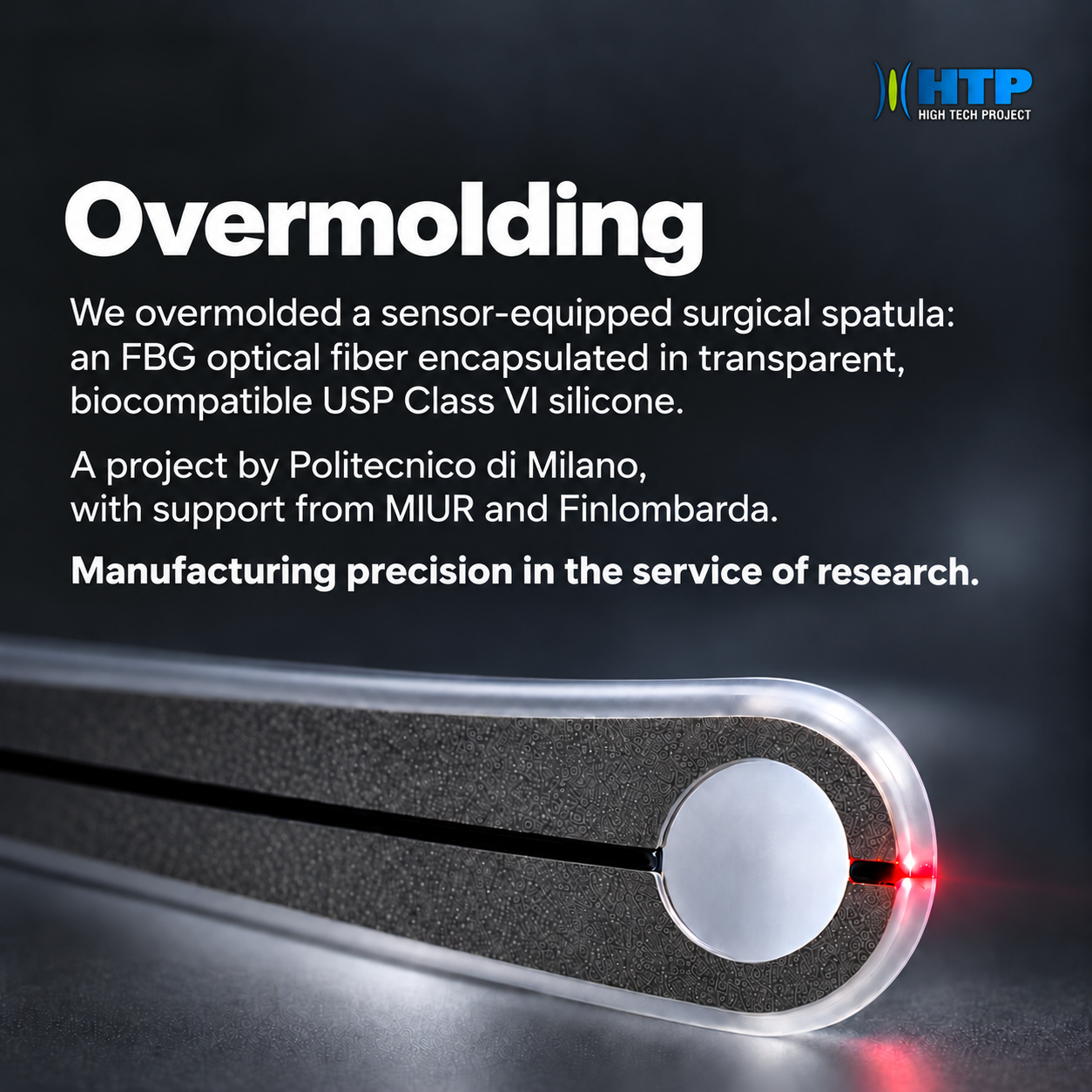
A few years ago we were involved in a funded research project, far removed from the automotive sector where we work every day.
A consortium of companies and researchers, in collaboration with Politecnico di Milano and funded through a MIUR call for proposals, was developing a sensor-equipped neurosurgical spatula. The goal: to give the surgeon, while operating on the brain, data they never had before — temperature, pressure, oximetry — turning manual sensitivity into numbers that can be read in real time.
The technological heart was an optical fiber with FBG sensors inscribed within it. Our contribution: to overmold that fiber onto a 304 stainless steel spatula with USP Class VI silicone — certified for contact with the human body — forming a raised button at the exact point of the sensor, from which the fiber exited to connect to the reading instrumentation.
Overmolding an optical fiber is not trivial. The fiber tolerates neither excessive pressure nor uncontrolled temperatures: we had to develop specific techniques to manage the process without compromising either the sensor or the signal transmission. Expertise that remains part of HTP’s know-how.
One hundred samples produced, working prototypes also validated on animal models, with a positive outcome.
The project did not reach industrial production. It remains, however, proof that overmolding can enter contexts that go well beyond traditional industry — structural monitoring, sensors for medical applications, fiber-based distributed measurement systems.
Not every interesting project becomes a product. This remains one of the jobs we are proudest of.
Foresti Alexander